Here is the polished EV-erything.com version, structured for publication.
Volkswagen ID. Tiguan – Everything We Know So Far
VW’s ID.4 Replacement Gets a Familiar Name, More Range and Better Technology
Volkswagen is preparing one of its most important electric SUVs yet.
The new Volkswagen ID. Tiguan will effectively replace both the ID.4 and ID.5, bringing Volkswagen’s electric SUV range under one of the company’s best-known model names.
The world premiere is scheduled for October 9, 2026, with the first cars expected to reach the market in early 2027.
But the ID. Tiguan is not simply an ID.4 with a different badge.
Volkswagen is introducing an updated MEB+ platform, new battery options, improved efficiency, revised suspension, a more conventional SUV design and — perhaps most importantly — a major rethink of the interior controls.
Here is everything we know so far.
EV-erything Quick Facts
| Volkswagen ID. Tiguan | Current information |
|---|---|
| World premiere | October 9, 2026 |
| Market launch | Early 2027 |
| Replaces | ID.4 and ID.5 |
| Platform | MEB+ |
| Battery options | 58 kWh LFP / 77 kWh NMC |
| Drivetrain | RWD / AWD 4Motion |
| Power | Approx. 188 / 282 / 295 hp |
| Maximum range | Approx. 600 km / 373 miles WLTP |
| Maximum towing capacity | Approx. 2,000 kg |
| Wheels | Up to approximately 21 inches |
| One-pedal driving | Expected |
| Physical steering-wheel buttons | Yes |
| Frunk | Not yet confirmed |
| DC charging | Final figures not yet confirmed |
| Price | Not yet announced |
Why Volkswagen Is Calling It ID. Tiguan
Volkswagen is gradually moving away from the numbered naming strategy used for its first generation of ID electric cars.
Instead, familiar Volkswagen names are returning.
The emerging strategy looks like this:
ID.2 → ID. Polo
ID.2 X → ID. Cross
ID.4 / ID.5 → ID. Tiguan
This makes sense.
Tiguan is already one of Volkswagen’s most recognisable SUV names, while names such as ID.4 require customers to learn an entirely new hierarchy.
The combustion-engine and plug-in hybrid Tiguan will continue to exist alongside the electric ID. Tiguan.
MEB+ Platform
The ID. Tiguan is based on Volkswagen’s upgraded MEB+ electric vehicle architecture.
This is important because MEB+ is designed to fix several weaknesses of the earlier MEB generation.
Expected improvements include:
- greater drivetrain efficiency
- improved battery technology
- better thermal management
- improved charging performance
- new software architecture
- updated chassis control
- better energy consumption
- lower production costs
However, this is still fundamentally an evolution of MEB.
The ID. Tiguan is therefore not a full 800-volt EV architecture in the same sense as some Hyundai, Kia, Porsche, Audi and upcoming BMW models.
That makes the final charging specification particularly important.
Battery Options
Two main battery configurations are currently expected.
58 kWh LFP
The entry-level ID. Tiguan is expected to use a 58 kWh LFP battery.
Range is currently expected to be around:
450 km / 280 miles WLTP
The introduction of LFP is significant for Volkswagen.
Lithium iron phosphate batteries generally offer:
- lower manufacturing cost
- strong durability
- long cycle life
- good thermal stability
- less dependence on nickel and cobalt
- greater tolerance for frequent charging to 100%
This could make the smaller-battery ID. Tiguan particularly attractive as a lower-cost family EV.
77 kWh NMC
Higher specification versions are expected to use a 77 kWh NMC battery.
The headline figure is potentially:
Up to approximately 600 km / 373 miles WLTP
If Volkswagen achieves that with a battery of around 77 kWh usable capacity, it would represent a significant improvement in vehicle efficiency.
Motors and Performance
Three main drivetrain configurations are expected.
ID. Tiguan 58 kWh RWD
Approximate output:
188 hp / 138 kW
This is likely to become the entry-level version.
ID. Tiguan Pro RWD
Approximate output:
282 hp / 210 kW
This is likely to offer the best combination of range, performance and efficiency.
Prototype reports suggest 0–100 km/h performance of roughly 7 seconds.
ID. Tiguan Pro 4Motion
Approximate output:
295 hp / 220 kW
The 4Motion version adds a second electric motor to provide all-wheel drive.
For Northern European markets, this could become one of the most desirable versions.
Up to 600 km of Range
Perhaps the most impressive early figure surrounding the ID. Tiguan is its expected range.
Volkswagen appears to be targeting approximately:
600 km WLTP from the 77 kWh battery
The interesting part is that Volkswagen is not simply installing a huge battery.
Instead, improved range appears to come mainly from better efficiency.
Likely improvements include:
- more efficient motors
- reduced drivetrain losses
- improved aerodynamics
- better energy management
- lower auxiliary consumption
- improved thermal management
This could give the ID. Tiguan a meaningful efficiency advantage over the outgoing ID.4.
Charging – The Big Unanswered Question
This is probably the most important specification Volkswagen has yet to reveal.
Early information suggests charging performance may remain relatively close to the latest ID.4 generation, but final figures have not yet been confirmed.
For EV-erything, the important figures will be:
- peak DC charging power
- 10–80% charging time
- average charging speed
- charging curve
- cold-weather charging
- battery preconditioning
- manual preconditioning
- navigation-triggered preconditioning
Peak charging power alone does not tell the whole story.
A vehicle capable of sustaining a high charging rate for longer can outperform another EV with a much higher headline peak.
For a 2027 model, however, Volkswagen will face increasing pressure from newer 800-volt competitors.
Battery Preconditioning
Battery preconditioning is particularly important for drivers in colder climates.
For markets such as Sweden, Norway and Finland, we would like to see:
Automatic battery heating when navigating to a fast charger
plus:
Manual battery preconditioning
Ideally, Volkswagen should also clearly display battery temperature or charging readiness to the driver.
The final implementation remains to be confirmed.
Exterior Design
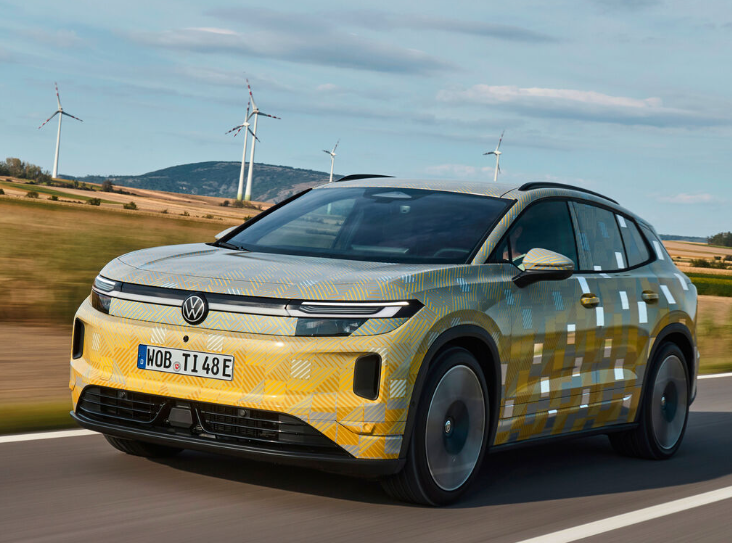
Volkswagen appears to be moving away from some of the softer styling of the ID.4.
The ID. Tiguan adopts a more traditional SUV appearance.
Expected design characteristics include:
- more upright front end
- sharper body surfaces
- stronger shoulder line
- narrower headlights
- full-width lighting elements
- illuminated Volkswagen badge
- conventional door handles
- more substantial SUV proportions
The styling direction appears much closer to the latest Volkswagen ID. Polo and ID. Cross design language.
For many buyers, that could make the ID. Tiguan feel more like a traditional Volkswagen and less like an experimental EV.
Dimensions
Early reports suggest that the ID. Tiguan is approximately 44 mm longer than the current ID.4.
That would put overall length at approximately:
4.63 metres
That places it directly in the heart of the European electric family SUV market.
Likely competitors include:
- Tesla Model Y
- Škoda Enyaq
- Hyundai Ioniq 5
- Kia EV5
- Renault Scenic E-Tech
- Ford Explorer EV
- BMW Neue Klasse iX3
Interior – Volkswagen Brings Back Physical Controls
This may be one of the most important changes.
Volkswagen received substantial criticism for the touch-sensitive controls fitted to several earlier ID models.
The ID. Tiguan appears to reverse that strategy.
Prototype interiors indicate the return of:
Physical steering-wheel buttons
along with improved tactile controls around the cabin.
This should significantly improve usability while driving.
For many ID.3 and ID.4 owners, this alone could make the new generation feel considerably more mature.
Large Central Infotainment Display
The ID. Tiguan is expected to use a central touchscreen of approximately 15 inches.
Expected functionality includes:
- Apple CarPlay
- Android Auto
- OTA updates
- EV route planning
- charging-stop planning
- online navigation
- voice control
- connected vehicle services
- improved charging information
Volkswagen has also been moving toward more advanced AI-based voice systems, although the exact functionality available in the ID. Tiguan remains to be confirmed.
One-Pedal Driving
One of the most welcome changes could be the introduction of stronger regenerative braking.
Prototype reports indicate that the ID. Tiguan will offer:
Adjustable regeneration and a true one-pedal driving mode
Earlier ID models have generally relied more heavily on adaptive coasting and moderate regeneration.
A proper one-pedal mode would give drivers more choice and bring Volkswagen closer to competitors such as Tesla, BMW, Volvo, Hyundai and Kia.
Improved Ride Comfort
Volkswagen has reportedly made extensive changes to the chassis.
These include revisions to:
- dampers
- suspension bushings
- steering
- chassis electronics
- vehicle dynamics software
Adaptive DCC suspension is also expected to remain available.
Prototype reports suggest that ride comfort has improved even when the vehicle is equipped with large 21-inch wheels.
This suggests Volkswagen is positioning the ID. Tiguan primarily as a comfortable long-distance family SUV rather than a sporty crossover.
4Motion All-Wheel Drive
The Pro 4Motion version adds all-wheel drive.
For drivers in Northern Europe, this version could be particularly attractive.
Potential benefits include:
- improved winter traction
- better performance on snow
- improved stability when towing
- better traction on gravel roads
- stronger acceleration
The exact torque distribution and performance specifications remain to be confirmed.
Up to 2,000 kg Towing Capacity
This could become one of the ID. Tiguan’s strongest practical features.
Early reports suggest a maximum braked trailer capacity of approximately:
2,000 kg
If confirmed, that would make the ID. Tiguan much more capable than many early electric SUVs.
It would also make it more suitable for:
- caravans
- boats
- utility trailers
- horse trailers
- heavier recreational equipment
For markets such as Scandinavia, Germany and the Netherlands, towing capability could become an important selling point.
Will the ID. Tiguan Have a Frunk?
At the moment:
Not confirmed.
Changes to the MEB+ packaging could potentially create additional front storage space.
However, until Volkswagen confirms this officially, EV-erything would list:
Frunk: TBC
What Happens to the ID.5?
The ID. Tiguan is expected to replace both the ID.4 and ID.5.
This means Volkswagen appears to be simplifying its electric SUV range.
Rather than maintaining separate conventional SUV and coupé-SUV variants, the company may concentrate on the ID. Tiguan as the main model in this segment.
Whether a more coupé-like derivative appears later remains unknown.
When Does the VW ID. Tiguan Arrive?
Current timeline:
September 28, 2026
Volkswagen officially confirms the ID. Tiguan.
October 9, 2026
World premiere.
Early 2027
European market launch.
Pricing and detailed market specifications have not yet been announced.
Expected Price
Volkswagen has not announced official pricing.
The most likely strategy would place the ID. Tiguan broadly around the current ID.4 price range, although higher equipment levels and new technology could increase prices.
The introduction of the 58 kWh LFP battery could help Volkswagen create a more affordable entry model.
Much will depend on how aggressively Volkswagen wants to compete with:
- Tesla
- Škoda
- Kia
- Hyundai
- Renault
- BMW
- Chinese EV manufacturers
Confirmed vs Reported
Confirmed
Model name: Volkswagen ID. Tiguan
World premiere: October 9, 2026
Launch: Early 2027
Position: Successor to ID.4 and ID.5
Platform: Updated MEB architecture / MEB+
Major interior rethink: Yes
Return of physical controls: Yes
Reported / Expected
The following details should still be treated as preliminary until Volkswagen releases the full technical specification:
- 58 kWh LFP battery
- 77 kWh NMC battery
- approximately 600 km WLTP maximum range
- 188 hp entry model
- 282 hp Pro RWD
- 295 hp Pro 4Motion
- approximately 2,000 kg towing capacity
- 21-inch wheel option
- true one-pedal driving
- frunk
- final DC charging speeds
The Six Things We Will Be Watching at the World Premiere
1. Real Charging Performance
Not just peak kW.
We want:
10–80% charging time and the complete charging curve.
2. Battery Preconditioning
Automatic and manual preconditioning should be standard on a modern European EV.
3. 600 km Range
If Volkswagen confirms around 600 km from the 77 kWh battery, the ID. Tiguan could become a very efficient electric SUV.
4. LFP Battery
The 58 kWh LFP version could potentially become the most important version in terms of sales volume.
5. Towing Capacity
A confirmed 2,000 kg towing limit would make the ID. Tiguan unusually capable for its class.
6. Price
Volkswagen needs to remain competitive.
Range and technology matter, but pricing will determine whether the ID. Tiguan can challenge the Tesla Model Y and its growing list of European, Korean and Chinese rivals.
EV-erything Verdict So Far
The Volkswagen ID. Tiguan looks like a much more substantial update than a simple ID.4 replacement.
Volkswagen appears to be correcting many of the weaknesses found in its first generation of electric cars.
The improvements potentially include:
- longer range
- higher efficiency
- LFP battery technology
- improved software
- better interior ergonomics
- physical controls
- one-pedal driving
- improved suspension comfort
- stronger towing capability
- more conventional SUV styling
The biggest remaining question is charging.
If Volkswagen combines approximately 600 km of range with strong battery preconditioning, a competitive DC charging curve and sensible pricing, the ID. Tiguan could become one of the most important European electric SUVs of 2027.
The full picture should emerge on October 9, 2026.