
…..that everyone needs and can afford?
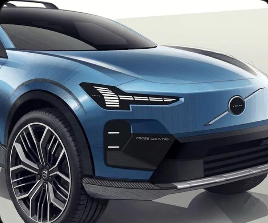
Could this be the look?
Volvo EX50: everything we know so far
The Volvo EX50 is shaping up to be Volvo’s next-generation compact electric SUV—effectively the eventual successor to today’s EX40. It should sit between the small EX30 and midsize EX60, competing directly with the Tesla Model Y, Audi Q4 e-tron, BMW iX1/iX2, Mercedes GLA EV and next-generation Polestar 2.
The important caveat: Volvo has not officially unveiled or fully confirmed the production model yet. There are no official photographs, specifications, Swedish prices or order dates. Some online “EX50 images” and videos are unofficial renders.
Current status
| Detail | Current information | Confidence |
|---|---|---|
| Name | Volvo filed the EX50 trademark in the EU on 14 July 2026 | Confirmed |
| Vehicle type | Five-seat compact electric crossover/SUV | Very likely |
| Position | Between EX30 and EX60 | Very likely |
| EX40 replacement | Reported, particularly for the US | Likely |
| Platform | Volvo’s new scalable SPA3 EV architecture | Reported/likely |
| Production | Expected during 2027 | Reported |
| Market introduction | Probably late 2027 or early 2028 | Estimated |
| Sweden/Europe | Almost certain, but not formally announced | Very likely |
| Official design | Not revealed | Unknown |
| Swedish price | Not announced | Unknown |
Volvo’s EU trademark filing covers cars and electric vehicles, but a trademark alone does not guarantee production. More recent industry reporting nevertheless says the EX50 is a real development programme and is intended to replace the ageing EX40. Electrek, MotorTrend
What kind of car will it be?
The EX50 should be a relatively conventional, practical five-seat SUV—not simply a raised hatchback and not as large as the EX60.
Reports indicate that it will be longer and taller than today’s EX40. That suggests approximately:
- Length: around 4.50–4.65 metres
- Width: around 1.86–1.90 metres excluding mirrors
- Height: around 1.63–1.67 metres
- Five proper seats
- Approximately 500–600 litres of luggage capacity
- Small front luggage compartment
- Likely towing capacity of roughly 1,500–2,000 kg, depending on powertrain
These dimensions and capacities are estimates, not released specifications. Today’s EX40 is 4.44 metres long, while the EX60 is approximately 4.80 metres, leaving a clear space for an EX50.
The crucial improvement: SPA3
The biggest story is not the name—it is the expected move from the EX40’s old CMA architecture to SPA3, Volvo’s dedicated and highly scalable electric-car platform.
The current EX40’s CMA platform was originally designed to accommodate combustion engines, hybrids and EVs. SPA3 is electric-only and should provide:
- 800-volt electrical architecture
- Faster DC charging
- Better energy efficiency
- More cabin space relative to exterior dimensions
- Cell-to-body battery construction
- Fewer components and lower manufacturing cost
- Megacast structural components
- Volvo-developed electric motors
- More powerful central computing
- Longer software support and more substantial OTA upgrades
SPA3 made its production debut in the EX60, which uses 800 volts and can charge its 83-kWh battery from 10–80% in about 16 minutes under ideal conditions. The platform also accommodates considerably larger batteries. Volvo EX60 specifications
The EX50 will probably use a smaller and less expensive version of the architecture.
Expected batteries and range
Nothing is confirmed, but a plausible range structure would be:
| Possible version | Estimated battery | Estimated WLTP range |
|---|---|---|
| Standard Range RWD | 60–70 kWh | 450–520 km |
| Long Range RWD | 75–85 kWh | 580–680 km |
| Long Range AWD | 75–85 kWh | 520–620 km |
A lower-cost LFP battery has been rumoured for an entry version. Longer-range models would probably use an NMC-type battery for higher energy density.
My realistic target for the most efficient EX50 is around 650 km WLTP. Claims of 700–800 km should be treated cautiously unless Volvo gives the car a surprisingly large battery. The EX60 can reach 810 km, but it achieves that with a much larger long-range battery and a higher price.
For comparison, today’s Swedish EX40 offers:
- Single Motor: up to 477 km
- Single Motor Extended Range: up to 572 km
- Twin Motor Performance: up to 537 km
Those are official current WLTP figures. Volvo EX40
Charging
If the EX50 inherits the key SPA3 technology, charging could be one of its strongest advantages.
My expectation:
- 800-volt system
- Approximately 250–320 kW peak DC charging
- 10–80% in approximately 17–21 minutes
- Battery preconditioning through Google Maps
- 11 kW AC charging as standard
- Possibly 22 kW AC on selected versions or markets
- Plug & Charge capability
- Potential bidirectional charging/V2H support
The actual charging curve matters more than peak power. A stable 200–250 kW through much of the session would make the EX50 a much stronger long-distance car than today’s EX40.
Power and performance
Volvo will probably offer rear-wheel drive and all-wheel drive.
| Possible version | Estimated output | Estimated 0–100 km/h |
|---|---|---|
| Single Motor RWD | 250–320 hp | 5.8–7.0 sec |
| Twin Motor AWD | 400–500 hp | 4.0–5.0 sec |
| Performance AWD | Possibly over 500 hp | Under 4.5 sec |
All versions will almost certainly retain Volvo’s 180 km/h top-speed limit.
Do not take reports of 670 hp as confirmed. That figure comes from the larger SPA3-based EX60 P12 and does not mean Volvo will install the same drivetrain in the EX50.
Interior and technology
Expect the EX50 to follow the EX60 rather than simply reproduce the very minimalist EX30 cabin.
Likely equipment includes:
- A central portrait touchscreen
- A separate driver display
- Google Maps, Google Play and Google Gemini built in
- Wireless Apple CarPlay
- Volvo Cars app and phone-as-key
- Qualcomm Snapdragon cockpit processor
- NVIDIA-based safety and driver-assistance computing
- 5G connectivity
- Frequent over-the-air software updates
- Bose and possibly Bowers & Wilkins audio options
- Sustainable textile, wool-blend and synthetic upholstery choices
A separate driver display is not confirmed, but I think it is probable. One of the EX30’s most criticised decisions was placing virtually everything—including speed—in the central display. The more expensive EX50 needs to feel like a conventional premium Volvo.
Safety
This should be one of the EX50’s strongest areas. Likely features include:
- Automatic emergency braking
- Cyclist and pedestrian detection
- Blind-spot monitoring with steering intervention
- Cross-traffic braking
- Lane centring and adaptive cruise control
- Pilot Assist with assisted lane changes
- Driver-monitoring camera
- Occupant sensing
- Door-opening warning
- Advanced interior radar
- Volvo’s new adaptive restraint technology
The EX60 introduced Volvo’s multi-adaptive front safety belt, which adjusts protection using information about the occupant and accident. It is not confirmed for the EX50, but SPA3 makes it technically plausible.
A lidar sensor is less certain. Volvo may rely on cameras, radar and ultrasonic sensing to keep the EX50 affordable.
Expected design
There are no authentic production images yet, but the design will probably combine:
- EX60-like proportions
- Closed aerodynamic nose
- Pixel-style Thor’s Hammer headlights
- Vertical Volvo rear lights
- Cleaner surfaces than the EX40
- More rounded roof and windscreen for efficiency
- Flush or semi-flush door handles
- Optional panoramic glass roof
- Possible Cross Country version later
I expect it to look like a smaller, slightly more upright EX60 rather than an enlarged EX30.
Price in Sweden
The present EX40 starts at 529,900 kr, while the EX60 starts at 689,000 kr. Volvo EX40, Volvo EX60
That leaves a fairly narrow pricing corridor. My estimate in today’s money is:
| Possible model | Estimated Swedish starting price |
|---|---|
| EX50 Standard Range | 499,000–539,000 kr |
| EX50 Long Range | 549,000–599,000 kr |
| EX50 AWD | 599,000–659,000 kr |
| High-spec Ultra/Performance | 650,000–700,000 kr |
The entry price could be lower if Volvo uses an LFP battery and deliberately targets the Tesla Model Y. Industry reports suggest a US price in the high-$40,000 range, below the outgoing American EX40. European pricing may follow the same relative positioning.
EX50 versus today’s EX40
| Area | EX40 | Expected EX50 |
|---|---|---|
| Platform | CMA, multi-energy | SPA3, electric-only |
| Electrical system | 400 V | Likely 800 V |
| Maximum range | Up to 572 km | Possibly 600–680 km |
| DC charging | Approximately 200 kW | Possibly 250–320 kW |
| 10–80% | Around 26–28 min | Approximately 17–21 min |
| Interior space | Good, but compromised platform | Better packaging |
| Software | Google-based, older hardware | HuginCore/next generation |
| Design origin | Electric adaptation of XC40 | Purpose-built EV |
| Production life | Mature and proven | New-car/software risk |
The EX50 should be better in almost every technical respect. The EX40’s advantages will be mature software, known reliability and potentially substantial end-of-production discounts.
EX50 versus EX60
| Area | Expected EX50 | EX60 |
|---|---|---|
| Length | Approximately 4.5–4.65 m | Approximately 4.8 m |
| Position | Compact family SUV | Midsize premium family SUV |
| Range | Perhaps 450–680 km | Up to 810 km |
| Starting price | Perhaps 500,000–550,000 kr | 689,000 kr |
| Towing | Estimated 1,500–2,000 kg | Up to 2,400 kg |
| Best for | Normal family use and value | Maximum space, range and towing |
The EX50 could be the more rational choice. The EX60 will remain better for long-distance travel, a large family, heavy trailers and maximum comfort.
Main competitors
When it arrives, the key rivals should include:
- Tesla Model Y
- Audi Q4 e-tron successor
- BMW iX1 and future Neue Klasse compact SUV
- Mercedes-Benz electric GLA
- Volkswagen ID.4 successor
- Skoda Elroq and Enyaq
- Kia EV5
- Hyundai Ioniq 5
- Polestar 4
- Zeekr 7X
- Xpeng G6
- Ford Explorer EV
The EX50’s strongest selling combination would be Volvo safety, Scandinavian comfort, 800-volt charging, European production and a price close to the Model Y.
Potential weaknesses and risks
The biggest concerns are:
- Volvo has not officially confirmed the specification or launch programme.
- Late 2027 is still far away, and competitors will improve meanwhile.
- First-year Volvo EVs have previously experienced software delays and missing features.
- Cell-to-body construction can make major battery or structural repairs more complicated.
- A touchscreen-heavy interior may frustrate drivers who want physical controls.
- Volvo may price desirable equipment and AWD too close to the EX60.
- Insurance and repair costs could be relatively high.
- Real winter range in Sweden will be substantially below WLTP.
For Swedish winter use, I would want proof of strong battery preconditioning, a good heat pump, rapid cabin heating and a consistent cold-weather charging curve before recommending an early order.
Everything.com early verdict
The EX50 may become Volvo’s most important mass-market EV. It promises to combine the EX40’s useful size with the EX60’s much newer electric architecture.
If Volvo delivers around:
- 600–650 km WLTP,
- 10–80% charging in under 20 minutes,
- a practical 500+ litre boot,
- 1,800–2,000 kg towing,
- and a starting price near 530,000 kr,
then the EX50 could be a genuinely strong Swedish alternative to the Tesla Model Y and one of the most interesting family EVs of 2027–2028.
For now, however, wait rather than plan a purchase around it. The name is real and the development reports are credible, but almost all detailed specifications remain estimates. The first meaningful milestone will be Volvo’s official announcement or prototype reveal.