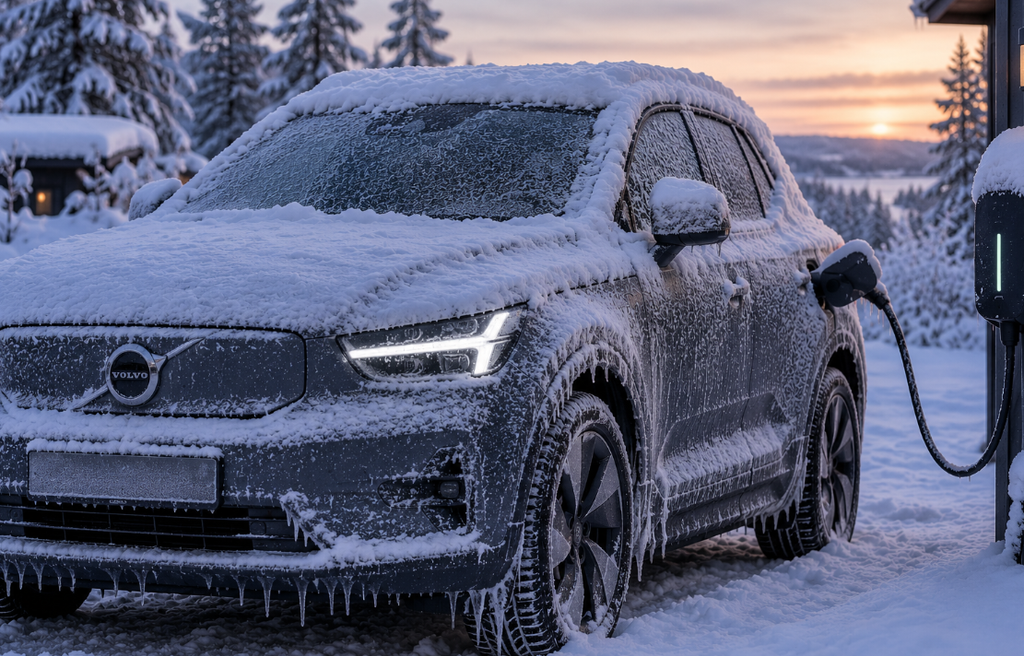
The most logical way to think about winter EV driving is:
Prepare the car → drive efficiently → charge correctly → park correctly.
1. Before driving – this can save a lot of range
If the car is connected to an AC charger, preheat the cabin while the car is still plugged in. This allows the car to use electricity from the grid instead of drawing energy from the battery.
If your car can precondition the battery, this is also very useful, especially before longer journeys and DC fast charging. A cold battery can result in both higher energy consumption and significantly slower charging.
Remove snow and ice properly. Snow on the roof and around the wheel arches adds weight and aerodynamic drag, while snow or ice covering radar sensors and cameras can interfere with ACC and other driver-assistance systems.
2. When you start driving
The first few kilometres are often the most energy-intensive because the battery, cabin and drivetrain are all cold.
Drive smoothly until the car warms up. Hard acceleration increases energy consumption, and a very cold battery may also limit both power output and regenerative braking.
Use seat heating and steering-wheel heating, and consider lowering the cabin temperature slightly. Heating the occupants directly requires much less energy than heating the entire cabin.
For example, around 19–20°C combined with seat heating will normally use less energy than maintaining 22–23°C with a high fan speed.
3. While driving – speed is one of the biggest factors
At motorway speeds, speed itself is one of the biggest influences on range, after outside temperature.
As a rule of thumb, the difference between driving at around 100 km/h and 120 km/h can be considerably larger than the difference between Eco and Normal driving modes. Aerodynamic drag rises rapidly as speed increases.
For maximum winter range, keep a steady speed, use adaptive cruise control when traffic conditions allow, avoid unnecessary acceleration and braking, consider driving at 100–110 km/h rather than 120 km/h when range matters, and check tyre pressure regularly.
Tyre pressure falls as temperatures drop. Underinflated tyres can noticeably increase energy consumption.
4. Regenerative braking – use it intelligently
Regenerative braking is useful, but the most efficient approach is actually to avoid unnecessary braking in the first place.
Maintaining momentum at a steady speed is usually more efficient than accelerating and then recovering only part of that energy through regeneration.
On slippery roads, strong regenerative braking can also feel different compared with summer driving. The car will normally regulate this automatically, but aggressive one-pedal driving may be less comfortable on very slippery surfaces.
5. Before DC fast charging – especially important in winter
This is where many EV drivers lose a lot of time.
A cold battery can dramatically reduce charging speed.
If your car has automatic battery preconditioning, enter the DC charger as the destination in the car’s built-in navigation system, rather than relying only on Google Maps or Apple Maps through CarPlay. In many EVs, the built-in navigation system is what triggers battery preconditioning.
Ideally, the battery should have perhaps 20–40 minutes of driving and/or preconditioning before reaching the charger, depending on the outside temperature and the vehicle.
In winter, it is therefore often better to drive for a while and fast-charge later rather than stopping at a DC charger immediately after the car has been parked outside overnight.
6. When DC fast charging
For the fastest charging stops, it is normally best to arrive with a relatively low battery state of charge.
A good long-distance strategy is often approximately:
10–15% → DC charge to 60–80% → continue driving.
The reason is that the battery normally accepts the highest charging power at relatively low states of charge. Above approximately 70–80%, charging power usually begins to drop significantly.
Charging from 80% to 100% can therefore take disproportionately long compared with charging earlier in the battery’s charging curve.
During winter, however, it is sensible to keep a slightly larger safety margin than in summer. I would not normally plan to arrive at the next charger with only 1–2% remaining under winter conditions.
7. AC charging at home – simplest and usually best
The basic principle at home is:
Leave the car plugged in.
This allows the vehicle to use grid electricity for cabin heating and, where supported, battery heating before departure.
For daily driving, there is normally no need to charge to 100%. For many NMC batteries, something like 70–80% is a sensible everyday charging limit.
Before a longer journey, however, you can charge to 100% shortly before departure.
If the car uses an LFP battery, the manufacturer’s recommendations may be different. Some LFP-equipped vehicles recommend regular charging to 100% to maintain accurate battery calibration.
8. Try to finish charging shortly before departure
This is a useful winter technique.
If you schedule AC charging so that it finishes close to your departure time, the battery will already have been warmed slightly by the charging process.
For example:
Departure 07:00 → charging completes around 06:30–07:00 → cabin preheating starts around 06:30.
This is better than completing the charge at 23:00 and leaving the car outside cooling down for eight hours.
9. Parking in cold weather
There is nothing inherently wrong with leaving an EV parked outside in freezing temperatures.
However, try not to leave it parked for a long period with a nearly empty battery. The vehicle may need energy for battery temperature management and it is also useful to maintain a reasonable safety reserve.
If the car is going to remain parked for an extended period in winter, something around 40–60% charge is generally preferable to leaving it at 5–10%.
10. How to maximise winter range
If the objective is to maximise winter range, I would prioritise these factors roughly in this order:
- Preheat the car while it is plugged in.
- Reduce motorway speed.
- Use seat and steering-wheel heating with a moderate cabin temperature.
- Maintain correct tyre pressure.
- Remove the roof box when it is not needed.
- Drive smoothly and maintain momentum.
- Navigate to DC chargers using the car’s own navigation system so battery preconditioning can activate.
- Schedule charging to finish close to departure time.
- Keep a larger range reserve during winter.
- Do not expect WLTP range in cold weather.
A good practical winter routine
The evening before: plug in the car and select the desired charging limit.
30–45 minutes before departure: start cabin preheating while the vehicle is still connected to the charger.
For a long journey: enter your route and the next DC fast charger into the car’s built-in navigation system.
While driving: use approximately 19–20°C cabin temperature, seat heating, smooth driving and, if necessary, slightly lower motorway speeds.
At the DC charger: ideally arrive with around 10–20%, charge to approximately 70–80%, and continue your journey.
When you get home: connect the AC charger and leave the car plugged in.