
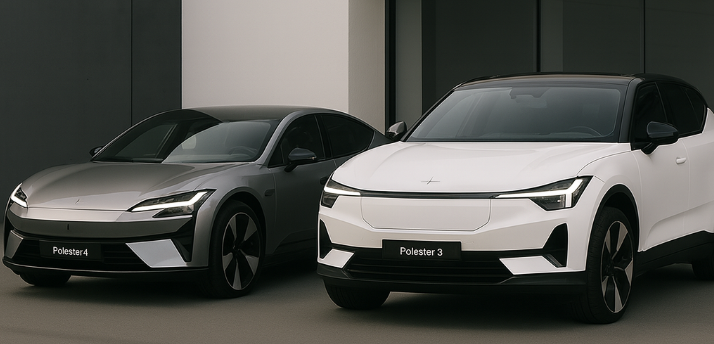
1. Core spec – “family” long-range versions
Polestar 4 Long range Dual motor – Polestar 3 Long range Dual motor
| Polestar 3 Long range Dual motor | Polestar 4 Long range Dual motor | |
|---|---|---|
| Segment / body | Large SUV | SUV-coupé (lower, more aero, no rear window) |
| Platform / voltage | SPA2-based, 400 V EV (current MY24–25) | Geely SEA-based, 400 V EV |
| Battery (gross/usable) | 111 kWh pack (usable ~107 kWh) | 100 kWh pack, cell-to-pack, 110 cells (usable ~94–100 kWh depending on source) |
| WLTP range (official) | 636 km (Dual motor), 567 km with Performance pack; 706 km for Single motor version. | ≈580–590 km Dual motor (P4 brochures & spec sheets); 610–620 km Long range Single motor. |
| Real-world mixed (EU tests) | Dual Motor Performance: ~400–480 km depending on conditions. | LR Single Motor: EV-DB “real” ~495 km; Dual Motor ~470–500 km. |
| Power / torque | 360 kW / 840 Nm (Dual motor); 380 kW / 910 Nm with Performance pack. | 400 kW / 686 Nm (Dual motor); 200 kW / 343 Nm Single motor. |
| 0–100 km/h | 5.0 s (Dual motor), 4.7 s with Performance pack. | 3.8 s (Dual motor), 7.1 s Single motor. |
| Top speed | 210 km/h (Performance), 205–210 km/h overall. | 200 km/h. |
| DC fast charge | Up to 250 kW, 10–80% in ~30 min (400 V architecture). | Up to 200 kW, 10–80% in ~30 min. |
| AC charging | 11 kW, 0–100% in ~11 h. | 11 kW standard (0–100% ~11 h), 22 kW with Plus pack (~5.5 h). |
| Dimensions (L x W x H) | ≈4.90 m x 1.96 m x 1.62 m (large SUV footprint). | ≈4.84 m x 2.00 m x 1.53 m (lower, wider coupé-SUV). |
| Boot volume | ~484–597 L; ~1,400–1,500 L seats down (exact figure varies by source/pack). | 500 L quoted by multiple spec sheets/dealers. |
| Tow rating (braked) | Around 2,000 kg (varies slightly by trim). | Typically 1,500–1,800 kg depending on version/market; Swedish ads often list 1,500–1,800 kg for Dual motor. |
Simple read:
- Polestar 3 = bigger, heavier SUV, more battery (111 kWh) and more space, very strong range in Single motor form (706 km WLTP).
- Polestar 4 = lower, more aero SUV-coupé, slightly smaller battery (100 kWh) but still long range, and much quicker in Dual-motor form (3.8 s).
2. Infotainment & interior / UX
Both cars use Android Automotive OS with Google built-in (Maps, Assistant, Play Store). Differences are mostly packaging, screens and layout.
2.1 Hardware & layout
| Area | Polestar 3 | Polestar 4 |
|---|---|---|
| Main screen | Portrait 14.5″ centre display with Android Automotive, similar layout to Polestar 2 but more SUV-optimised. | Landscape 15.4″ centre display, very clean “floating” design with AAOS, larger than P3’s in total width. |
| Driver display / HUD | 9″ driver display + optional head-up display, more conventional SUV layout. | 10.2″ driver display + digital rear-view mirror (no rear window), optional HUD in some markets. |
| Rear view | Traditional rear window + camera. | No physical rear window – uses high-def rear camera feeding a digital mirror. Big talking point. |
| Rear seats / space | Classic SUV rear seats; generous headroom and a flat-ish floor, very “XC90-ish” in feeling. | Very spacious rear with reclining seats + rear control/entertainment screen, but slightly more cocooned thanks to the coupe roof and no rear glass. |
| Climate / controls | Most climate on the screen; physical buttons kept for some core functions, Volvo-style stalks and wheel. | Even more minimalistic: nearly everything through the central screen and steering wheel buttons; strong ambient-light themes. |
2.2 User experience (tests & early owner feedback)
- Polestar 3
- Feels very Volvo-premium SUV: high seating, airy glasshouse, straightforward menus.
- Testers like the ride/quietness and simple Google UI, but some criticise the start/stop procedure and the fact that it’s still “only 400 V” with 200–250 kW DC in a segment where 800 V rivals exist.
- Polestar 4
- Described as more futuristic and tech-forward: minimalistic cabin, strong ambient lighting, more playful design.
- The camera rear mirror takes some getting used to; some love the visibility, others miss a normal window.
- Still Android Automotive, but no Android Auto/CarPlay in some early markets (phone projection via built-in apps instead). Reviewers praise tech feel but note high price when loaded.
3. Character & “problem pattern” so far
Polestar 3
- Very new, but already did well in winter range tests (Norge/Europa) thanks to big battery and careful energy management.
- Media criticism revolves around:
- High weight and size, so consumption is not Tesla-low in real life.
- 400-V architecture and max 200–250 kW DC seen as “only OK” vs newer 800-V luxury rivals.
- No major recall scandals yet; the bigger “drama” around Polestar 3 has been company-level (impairment charges, pricing pressure), not technical defects.
Polestar 4
- Also very new; lots of media focus on:
- No rear window → camera mirror. Some reviewers say they adapted quickly; others still prefer a glass rear.
- Ride/steering feel: sportier than Polestar 3 but not a hardcore sports car – more like a fast GT. Steering feedback gets mixed reviews.
- No large technical recall headlines yet; underlying tech is relatively simple (400 V, 200 kW DC), similar to other SEA-based cars.
4. Sweden: prices & leasing (late-2025 snapshot)
List prices – Sweden (approx, incl. VAT)
From Polestar SE spec/offers pages:
- Polestar 3 – Long range Single motor: from 890 000 kr
- Polestar 3 – Long range Dual motor: from 960 000 kr
- Polestar 3 – Long range Dual motor Performance: from 1 030 000 kr
- Polestar 4 – Long range Single motor: from 692 000 kr
- Polestar 4 – Long range Dual motor: from 722 000 kr
(Dealer campaigns often undercut those a bit; e.g. brandtbil/bilia/VolvoCarRetail listings show new P3 around 925k kampanjpris and P4 LR SM around 619–692k depending on offer.)
Typical private-leasing offers (36–48 months, ~1 500–3 000 mil/år)
- Polestar 3 Long range Dual motor Business edition
- Official Polestar SE: from 9 995 kr/month incl. Pilot + Plus packages, colour, tint, cable.
- Polestar 4 Long range Single motor / Dual motor
- Polestar SE: earlier offer from 9 927 kr/month (campaign now marked ended, but level is indicative).
- Dealer campaigns: e.g. 6 499–6 995 kr/month for LR Single / Dual motor with 0% ränta or intro deals.
So in Sweden right now:
- Polestar 3 sits clearly in “big luxury SUV money” (around 900k–1.0M).
- Polestar 4 undercuts it quite a bit on purchase price and often on leasing, especially Single motor LR.
Core “from” prices in Europe
| Model | Official EU / press “from” price | Current Germany “from” (campaigns etc.) | Notes |
|---|---|---|---|
| Polestar 3 | from €74,590 in Europe after price cut | Article in Welt says “starts at €79,000” in Germany right now (incl. current promo with free wallbox/charging credit). | Large luxury SUV, 111 kWh pack on current MY; MY26 will move to 800 V but prices not yet announced. |
| Polestar 4 | Global / DE indicative price from €61,900–63,200 incl. VAT and handover in Germany. | Same Welt piece quotes “from €58,000” in current German promo. | Coupe-SUV, 100 kWh pack; positioned clearly cheaper than P3 in EU. |
So, roughly:
- Polestar 3 → think €75–79k base in most Euro markets right now.
- Polestar 4 → think €58–63k base depending on market and campaign.
You can simply add a “Price from (EUR)” row to your P3 vs P4 matrix with:
- P3: “≈€75–79k (DE from ~€79k)”
- P4: “≈€58–63k (DE from ~€58k)”
5. Super-short “which for what?” summary
- Polestar 3
- ✅ You want a proper big SUV with maximum comfort, Volvo-like feel, lots of space, 706 km WLTP possible with Single motor.
- ✅ Great highway cruiser, strong comfort + safety vibe.
- ❌ Expensive, heavy, and charging/range are good but not “cutting-edge 800-V” vs some rivals.
- Polestar 4
- ✅ You want a sleeker, sportier, more tech-forward coupe-SUV with still long range and very fast Dual-motor performance (3.8 s).
- ✅ Cheaper to buy/lease than P3 in Sweden, still premium cabin and good space, but a bit lower / more GT-like.
- ❌ No rear window (camera mirror only) is love-it-or-hate-it; slightly smaller boot and more coupe-ish usability vs P3.