Do you want EV news in your mailbox every week – SUBSCRIBE
What Volvo EX60’s new handles are — and the trade-offs
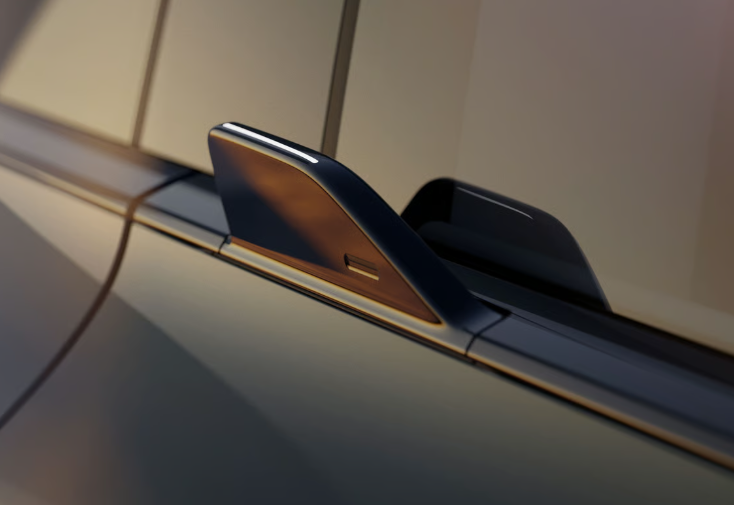
Volvo is using a new “wing-grip” / fin-like exterior solution integrated up by the lower edge of the side window area (i.e., not a classic door-skin pull handle). Volvo describes it as an innovative design to support styling and aerodynamics. (Volvo Cars)
Claimed advantages (why Volvo is doing it)
- Aerodynamics + clean surfacing: less disturbance than protruding handles; design integration. (Volvo Cars)
- Safety engineering focus (the key point): Volvo and reviewers emphasize redundancy—a combined electronic operation with a mechanical backup in the same pull motion (so the user doesn’t need to find a hidden emergency latch). (InsideEVs)
EV door-handle types (what exists, with practical pros/cons and “teething issues”)
1) Conventional “pull” handles (mechanical link)
Examples: many mainstream cars (often also on EVs like BMW iX1, many Renault/VW/Škoda variants depending on model year).
Pros: simplest, cheapest, best winter reliability, easiest for emergency services, intuitive.
Cons: slightly higher aero drag (usually minor), less “flush” aesthetics.
Typical teething issues: mainly cosmetic wear, occasional cable/lever wear over time (rare early-life systemic issues).
2) Flush “push-then-pull” (manual, but sits flush)
Examples: Tesla Model 3/Y style.
Pros: good aero + clean design; fewer exposed parts.
Cons: can ice-bind in winter; less intuitive for first-time users; can be harder with gloves.
Typical teething issues: freezing/ice preventing handle movement is explicitly addressed in Tesla cold-weather guidance. (Tesla)
3) Motorized “presenting” / retractable handles (electrically deploy)
Examples: several premium EVs (and some non-premium) with fully retractable handles.
Pros: best aero and “premium” feel; can integrate lighting/sensors.
Cons: reliance on low-voltage power and actuators; risk of sticking (ice/dirt), higher complexity/cost, and safety scrutiny if power is lost after a crash.
Typical teething issues: actuator failures, water ingress, icing, sensor misreads.
4) Button/sensor “e-latch” external release (handle may be minimal)
Examples: increasingly common; VW ID family uses electronically controlled exterior actuation.
Pros: sleek packaging; can reduce parts count; can enable soft-close / smart functions.
Cons: must be engineered with redundancy (mechanical backup) and clear emergency procedures; otherwise faces the same scrutiny as retractables.
Potential disadvantages / risks (what to watch in real life)
- User familiarity: anything non-standard creates a learning curve (visitors, taxis, kids).
- Winter usability: any small external “grip” can be impacted by ice buildup; Volvo’s final winter behavior will matter in Nordic conditions.
- System complexity: even with redundancy, more parts and validation burden vs. a purely mechanical pull handle.
What China has decided / is moving toward on door handles (why it matters)
China’s regulators (MIIT) have issued draft/consultation direction that, as reported, moves to restrict or ban fully retractable/hidden, electric-only exterior handles and mandates mechanical emergency release capability plus strength/usability requirements—reports cite implementation around 2027 for new vehicles. (#SixthTone)
This is relevant because one report covering the EX60 launch explicitly links Volvo’s comment that China’s upcoming legislation will constrain such solutions going forward. (electrive.com)
12 of the most common EVs in Europe (recent top sellers) + handle type + reported handle issues
Below uses the Top BEV models in Europe (H1 2025) list as the “most common” baseline (rankings vary by source/time window). (Best Selling Cars)
Legend (Handle type):
A Conventional mechanical pull
B Flush manual (push/pivot then pull)
C Electronic actuation / e-latch style
D Retractable/presenting (motorized)
| Model (Europe, common) | Handle type (typical) | Reported handle-related issues in public sources | Example photo source |
|---|---|---|---|
| Tesla Model Y | B | Cold-weather icing can block handle movement (documented guidance). Also: US NHTSA probe into Model Y exterior handle/lock non-opening complaints (2021 MY) (not an EU recall, but relevant signal). (Tesla) | Tesla manual exterior overview image. |
| VW ID.4 | C | Safety recall (57J9 / 24V651): water sealing/electronics issues could contribute to unintended handle behavior; remedy campaign reported. (NHTSA) | VW press image showing handle. |
| Tesla Model 3 | B | Cold-weather icing guidance exists for door handles. (Tesla) | Tesla manual exterior overview image (Model 3). |
| VW ID.7 | C | No widely documented handle-specific safety recall surfaced in the sources reviewed here (vs ID.4 which has one). | VW newsroom imagery (model page). |
| VW ID.3 | A/C (varies by year/trim) | No widely documented handle-specific safety recall surfaced in the sources reviewed here. | VW newsroom imagery (model page). |
| Kia EV3 | C/D (flush w/ powered presentation depending on spec) | Very new in market; no major, widely documented handle-specific safety recall found in the sources reviewed here. | Kia EU page (model). |
| Renault 5 | A/B (design-dependent; new model) | Very new in market; no major, widely documented handle-specific safety recall found in the sources reviewed here. | Renault media page (model imagery). |
| Škoda Elroq | A (most imagery shows conventional) | Very new in market; no major, widely documented handle-specific safety recall found in the sources reviewed here. | Škoda press kit imagery. |
| Škoda Enyaq | A | No widely documented handle-specific safety recall surfaced in the sources reviewed here. | Škoda storyboard imagery. |
| BMW iX1 | A | No widely documented handle-specific safety recall surfaced in the sources reviewed here. | BMW press imagery. |
| Audi Q6 e-tron | A/C (varies by spec) | New model; no widely documented handle-specific safety recall surfaced in the sources reviewed here. | Audi media imagery. |
| Volvo EX30 | A | No widely documented handle-specific safety recall surfaced in the sources reviewed here. | Example handle close-up from auto media. |
Important nuance on “reported problems”: for several models above, the absence of a cited “handle recall” does not mean “no owners ever had issues”—it means no widely documented, handle-specific safety recall/campaign was identified from the sources pulled for this response (whereas ID.4 and Model Y have clearly documented public items). (NHTSA)
Other EVs that are repeatedly discussed for handle/exit concerns (beyond the Top-12 list)
- VW ID.4: formal recall/campaign for handle-related defect (covered above). (NHTSA)
- Tesla (general): ongoing public debate about post-crash operability and user understanding of manual releases; Model Y probe is specifically documented. (Reuters)
- Hyundai/Kia (some models): there are owner discussions/videos alleging weak or broken handles in cold conditions (anecdotal rather than formal recall evidence). (YouTube)
If you want this as a deliverable for EV-erything.com
I can convert the table into:
- a clean web-ready matrix (English + Swedish columns),
- plus a “handle taxonomy” graphic section (types A–D),
- and a separate “Known recalls / investigations” box with citations.
Say the word and tell me whether you prefer H1 2025 as the baseline (used here) or full-year 2025 / YTD 2026 for the “most common” list.